
Kishore Singh: The ritual art of the thanka

TIBETAN ART

Lokesh Chandra
Niyogi Books
Rs 1,500; 216 pages

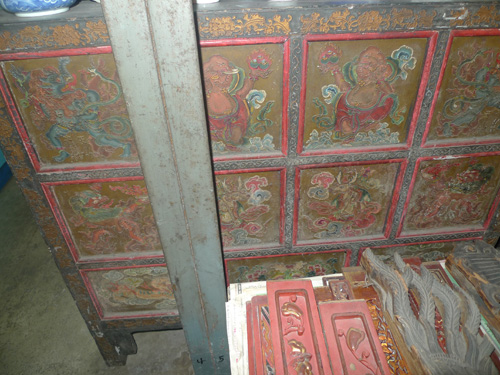
Once, many years ago, on a trip to Lumbini, the Buddha’s birthplace in Nepal, I was fascinated to come across a group of novitiate monks being trained in the making of thankas. Beginning with graph paper on which they learnt to place ritual subjects precisely, they drew outlines of the meditating Buddha, the lotus, the Green Tara and demons, clouds and water and deer and the wheel of dharma, drawn and drawn again and again till they were, quite literally, picture perfect.

Few people know the rigour that goes into these Tibetan paintings. They are, writes renowned Tibetan scholar Lokesh Chandra, usually painted by a lama “versed in sacred lore” who “accompanies his work by a continuation recitation of prayers”. The painter must be “a sacred person of good conduct”; the studio must be “in a clean place”; and the master artist works with “his disciples”. These paintings, which are an “iconic representation of transcendental meditation” are meticulously drawn “so that the minute details of the ornamentation are attended to before colouration”.

If the “face of a Buddha or Bodhisattva is preferably drawn on an auspicious date”, a “consecration ceremony” at the conclusion of the painting “makes it the habitation of the deity and his/her entourage”. Such strictures allow no room for individual artistic creativity and imagination — it is the lines, the colours and the details that make one work superior to another. The thankas, therefore, both tell popular tales as well as attest to the many variants or elements in Buddha’s story, a painted or visual guide for acolytes.

Lokesh Chandra’s lavishly illustrated volume serves as both a background as well as a guide to the many forms of Buddha, and of other heavenly (or hellish) forms, their representation, and the various meanings or implications of each. In that sense, of course, it could be a compendium or a guide for a thanka artist. Take the case, for instance, of the eleven-headed Avalokitesvara who was created thus: “Avalokitesvara descended into hell, converted the wicked, liberated them… He discovered, however, to his dismay, that for every culprit converted and liberated, another instantly took his place, and legend claims that his head split into ten pieces from grief and despair on discovering the extent of wickedness in the world, and the utter helplessness of saving all mankind”. The eleventh face is Dharma-kaya, writes Chandra, “white in complexion, he has eight hands”, but the eleven-headed heavenly being also has “a thousand hands, with an eye on the palm of each hand, and thus with a thousand eyes”. (Beat that, Rowling!)

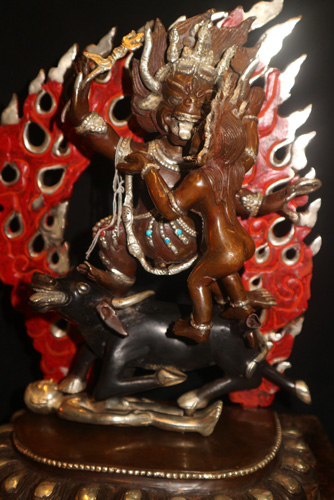
The book makes references to current initiation processes such as the Kalacakra as well as to Yab-Yum (akin to the Far Eastern ying-yang and the Hindu Ardhanariswara) which is symbolic of “the unity of the masculine and the feminine” usually as a sexual union of male and female consorts, the former representing “compassion” and the latter “linked to transcendental wisdom”. According to a certain school of Tibetan Buddhism, “instead of repressing the inborn libido of creatures, it is well to transfer it to higher planes,” which is again similar to tantric Hinduism.

Lokesh Chandra’s masterful treatise has one major flaw though: it preaches to the converted. For the lay reader, or collector of thankas, the language is laboured, the subject makes few concessions to those who may not exactly follow the flow of the scriptures or the rhythms and cadences of these delightful paintings and their apparently multi-layered interpretation of content. Had it been simpler, it would have found greater acceptance among those of us who enjoy looking at thankas but are still to find a book that interprets them simply and in less exhausting ritual reading!


Comments(0)

Big Buddha gets big bell (Thailand)

The bronze bell weighs in at one metric ton, dwarfing the other bells at the site.

KARON: Work on the the enormous Buddha image in the Nakkerd Hills is now about 90% complete and a huge bronze bell was installed at the site to mark King Chulalongkorn Memorial Day on Thursday.

The one-million baht bell, which weighs one metric ton, was a gift from the Rassada Cooperative Credit Union.

Work on the image, officially known as Phra Puttamingmongkol Akenakkiri, is now about 90% complete, according to the Mingmongkol Faith 45 committee that has funded the project though fund raising efforts.

Vice Governor Worapot Ratthasima attended the Buddhist ceremony at which gold leaf was applied to the bell and it was struck for the first time on Chulalakorn Day.

The entire Mingmongkol Buddha project, to include a landscaped park and museum, is expected to be complete by 2010, at a total cost in excess of 150 million baht.

Once completed, the 45-meter-high Buddha image is expected to become Phuket’s most popular man-made tourist attraction.

There has also been talk of installing a cable car from Patong to the site, which sits atop a 380-meter hilltop.


Comments(0)

Nara temple’s ancient ruins unearthed (Japan)

NARA–The ruins of a large building believed to be the Kondo main hall of the eighth-century Shin-Yakushiji temple in Nara have been excavated here from the campus of Nara University of Education, the university said Thursday.

Based on the ruins, the university said, the ancient building–which was destroyed for a second and final time in 962–was as big as the largest wooden structure still standing in the world today, the Great Buddha Hall in Todaiji temple in Nara, which dates to the Edo period (1603-1867).

The foundations of the ancient building are estimated to have stretched 54 meters from east to west and 27 meters from north to south.

Because there are few known remains of the Shin-Yakushiji complex, the discovery is of major importance in understanding the famous temple’s original structure.

According to records of Todaiji temple, Shin-Yakushiji temple was built in 747 by Empress Komyo, who prayed for the recovery of her ill husband, Emperor Shomu (701-756), and is believed to have had several buildings on its spacious grounds, including the Kondo main hall, two towers and a lecture hall.

The original temple complex was destroyed by fire started by lightning in 780. The complex was rebuilt, but the Kondo hall was again destroyed, along with other buildings, by strong winds in 962.

The Kondo hall of Shin-Yakushiji was never again reconstructed.

In the recent excavation, stones with a diameter of about 50 centimeters–believed to have formed the foundations on which pillars stood–have been unearthed from four locations.

(Oct. 24, 2008)

Comments(0)

The great quest (Lumpini)


TEXT & PHOTOGRAPHS: BENOY K. BEHL

After six years of wandering, Gautama Siddhartha attained his goal: he became a Buddha, one who had gained Bodhi.


Gilded statue of the Parinirvana. Like other sacred places associated with the life of the Buddha, Kushinagar, Uttar Pradesh, where the Buddha attained Parinirvana, rose to be an important place of pilgrimage and, in the course of time, was covered with shrines and monasteries built by Emperor Asoka and others. This is among the four most holy places for Buddhists.

IT was the beginning of the first millennium B.C. There were many principalities in the northern plains of India. Some of them were Jana-Samghas, ruled by elected councils. In others, the concept of hereditary leaders was evolving. It was a time when great philosophic concepts, which were to last forever, were being crystallised. By the 8th century B.C., the early Upanishads were composed, out of the continuing traditions of the land.

These verses speak of the oneness of the whole of creation. The world of separated forms, which we see around us, is considered to be maya, an illusion. We perceive this illusory world through our senses, which are subjective. The high purpose of life is to transcend these limitations: to lift the veils of illusion and to see beyond, to perceive the unity of all that there is and thereby to break out of the spell of the transitory world. The main illusion, which keeps us bound to the material world, forever seeking its fruits and benefits, is the ego. We imagine ourselves to be distinct and separate entities and forever chase our ambitions and desires. The spell has to be broken to attain the peace of the truth.

In this period, numerous thinkers gave up the attractions of the ephemeral world to pursue the search for the truth. They left behind their material possessions and the emotional bonds with their families to wander homeless. They sought to be free of the endless pursuit of desires in the mundane world. This would give them the opportunity to seek the truth, which was eternal and beyond the passing material illusions.


Monkey brings honey for the Buddha, pillar, North Gateway. Siddhartha realised that depriving his body of nourishment in rigorous self-denial only weakened it and his mind. When he decided to give up his extreme asceticism, a monkey brought honey for him to eat.
Read the rest of this entry »


Comments(0)

Haein Temple: 1,000-Year-Old Monastery With Tripitaka Koreana

Haein Temple: 1,000-Year-Old Monastery With Tripitaka Koreana


A Buddhist monk inspects a woodblock of Tripitaka Koreana, a national treasures of Korea and a UNESCO Cultural Heritage, at Haein Temple, South Gyeongsang Province. / Yonhap

By Choi Yearn-hong
Contributing writer

I visited the Haein Temple on Mt. Kaya in the southeastern part of Korea, a 1,000-year-old monastery, where I rediscovered the value of the Tripitaka Koreana, one of the National Treasures of Korea registered as a UNESCO Cultural Heritage.

Tripitaka is a Sanskrit word meaning “three baskets'’ that contains the Buddha’s teachings, his disciplines’ interpretations of his teaching, and the scholars’ interpretations and commentaries on the Buddha’s teaching. This is comparable to the Bible to the Christian people. The Tripitaka Koreana, consisting of more than 80,000 woodblocks, was made in 1251. There were many versions of the Tripitaka from India, Sri Lanka, China, Taiwan and Japan, but the Tripitaka Koreana has been the most complete and comprehensive of the “three baskets'’ and the best preserved over the years. This article is searching for the answers as to why the Tripitaka Koreana is a valuable UNESCO designated heritage for mankind, and how it has been preserved.
Read the rest of this entry »


Comments(0)

Exit Kali, enter theme scream

Exit Kali, enter theme scream

This Diwali, Monty Pal, son of acclaimed Kumartuli craftsman Sunil Pal, will have something other than a Kali idol to showcase — a horror house at the Rosevalley Park coming up in Barasat.

Monty, in fact, hasn’t made idols of Durga, Lakshmi and Kali in a long time. Most of the time, he is busy meeting deadlines for orders of fibreglass models.

The orders pour in from various parts of India and abroad. The 12-ft high fibreglass seated Buddha, for one. The image, an accurate replica of an ancient Korean Buddha, is currently on display at an exhibition in Brussels.

Another recent assignment was making seven fibreglass pieces for an installation by artist Praneet Soi in Amsterdam.

Monty is also the architect behind the Horror Cave in Alasa Leisure Land in Dubai, a river-cave ride for Southport and many pseudo Greek garden sculptures for hotels in and around the city.

But right now Monty is busy with Morgue No. 13, which will be displayed in Barasat, and Lal Kuthi, to be showcased in Digha. Both have been commissioned by Nicco Park, which already has the Scareey House in its Salt Lake property, made by Monty fouryears ago.

“Working for Nicco over a long period has resulted in the formation of a team. While Masood Huq does the basic drawings and layout, Jaladhar Mandal does the animation and Nicco officials record the eerie sound effects and train actors who are part of the show,” explains Monty, overseeing a craftsman working on a large head that will be part of the facade in the Barasat park. On an average, he earns Rs 2-4 lakh per project.

“This is what I enjoy doing and what has proved profitable,” says Monty. He has learnt the art of fibreglass modelling in Delhi.

Morgue No. 13 will be a two-storeyed house with rooms and balconies, all crammed with fibreglass dead bodies and body parts, some of which will be animated.

The facade will be a brick wall with the face of a horned animal that is half bull and half lion, and a network of thick creepers. The structure will be 25 ft high, while the rest of the house will cover 40 sq ft.

“There will be actors wearing masks and costumes, and some imported animation gadgets,” adds Monty.

Though he has a studio in Kumartuli, Monty has eight craftsmen working under him at a makeshift workshop in Nicco Park.


Comments(0)

Islamic and other artefacts to be auctioned off (Malaysia)

SERDANG: A copy of the oldest illuminated Quran in South-East Asia and a thousand-year-plus keris called Perabu are among the must-see artefacts that will be on display at an antique charity auction next week.

The Quran, which is 400 years old and owned by a Malaysian antique collector who declined to reveal his identity, is believed to be from Macassar, Sulawesi.

According to programme supervisor Dr Muhammad Pauzi Abd Latif, the Muslim holy book concerned has been authenticated as the oldest in the region by Dr Annabelle Teh Gallop, head of the South and South-East Asia section at the British Library in London.

Part of the proceeds from the charity auction will go towards financial aid for Universiti Putra Malaysia students who are facing problems paying their fees, he told a press conference here on Tuesday.

He said more than RM1mil was expected to be raised from the charity auction, adding that 80% of the items were owned by antique collector and licensed auctioner Radzuan Jamaluddin. The rest are from the Sultan Alam Shah Museum.

There will be 400 artefacts to be auctioned off and another 200 to be sold at the three-day event, which is scheduled to be launched by Tourism Minister Datuk Seri Azalina Othman Said at Sultan Shah Alam Shah next Saturday, Oct 26.

There will also be a 400-year-old Ottoman era manuscript, Eastern ornaments and woven fabrics, diamond and ruby brooches from Malacca, and a floral silk fabric from Johor called “cindai,” which is claimed to have medicinal properties.

Legend has it that the Malay warrior Hang Jebat was able to hold out for seven days after being stabbed by Hang Tuah because he used cindai to dress his wound.

The keris Perabu, owned by Radzuan, is from the Demak period, long before Islam came to the region.

Other Asian antiques of interest are a piece of cloth used to cover the Kaabah in Mecca and blinds from China.

There will also be European antiques, including a 17th century polyphone radio, a second-generation Thomas Edison radio from 1898, a 100-year-plus-old Singer sewing machine and a 1915 US-made type writer.

Bidding prices for the artefacts start at RM5,000 and go all the way up to RM500,000.


Comments(0)

1,900 yr old Buddhist monastery discovered in Gujarat

New Delhi, Oct 13 (ANI): Gujarat State Archaeological Department has discovered a small size Buddhist monastery in Gujarats Vadnagar, which dates back to 1,900 years.

According to a report in Desh Gujarat, the walls of the discovered monastery were built using bricks.

The 55 by 55 ft size monastery had a total of 12 cells for residual purpose of monks, with its entrance on the Northern direction.

This Buddhist monastery probably belongs to 2nd to 4th century era. It was probably in use for 300 years, said Gujarat State Archaeology Superintendent Dr. Yadubirsingh Rawat.

After two years of excavation, first we unearthed the monastery structure. For a brief time, it remained a mysterious structure for us as we couldnt figure out its motive. After some research, observations and studies, we have confirmed that this was a Buddhist monastery, he added.

Decades back in Gujarat, when double size Devni Mori Buddhist monastery was discovered, a similar lay-out plane was found there.

Devni Mori Buddhist monastery also had northern side entrance, South-Western drain, open plot in centre and 29 cells for monks around the central plot.

In the course of two years of excavation, so far more than 2000 pieces of Archaeological importance have been found from Ghaskol Darwaja excavation site in Vadnagar.

The findings include a 2000 year old house, numerous clay utensils, silver coins, beads, ornaments, Roman style head sculpture, turbaned face clay plaque, votive tablet, head sculpture, plaque sculpture depicting Buddha, and parts of vessel on which Buddhism related words are written in Brahmi script.

Chinese traveler Hieun Tsanghad visited Vadnagar between 640 to 644 A.D. and documented presence of 1,000 Buddhist monks and 10 Buddhist monasteries in and around Vadnagar town known as Anandpur in that era.

Decades back, a sculpture of Bhagvan Buddha was found from Vadnagar, which was then placed in Vadnagar museum for permanent exhibition.

At the newly discovered site, excavation in the southern direction is yet to begin. Possibility of finding Shrine cell and Buddha idol in this direction is quite high. (ANI)


Comments(0)

Fine Arts Department finds water damage in Doi Suthep Buddha Relic, request immediate renovation

by Amrit Rashmisrisethi -

The Department of Fine Arts and members of Chiang Mai University’s Engineering Faculty have found water damage to the inner layer of the Bhudda Relic on Doi Suthep spurring concerns of collapse and requests to renovate the structure.

Director of the Area 8 Department of Fine Arts in Chiang Mai province Sahawat Nannah (??????? ???????) revealed that his department along with Chiang Mai University’s Engineering Faculty have made inspections into the structural integrity of the Doi Suthep Buddha Relic. He said that the team, which is comprised of experts in civil engineering and structural weight dispersal, conducted their inspection due to constant rain during the period. They were concerned that the structure was bogged down in water and moisture was seeping into the relic. Their inspection did find considerable water damage within the structure with much of its dry walling completely water logged causing it to break off. Nails in the structure were also found to no longer be supporting it with only the relics frame holding its weight.

The Fine Arts Department has sent a memo to the Abbot of Wat Doi Suthep informing him of the situation and the need for immediate renovation on fears of collapse. Their memo was responded to with the request for renovations to wait, but the department is planning to present the matter to Prime Minister Somchai Wongsawat who will be visiting the province on October 1st.

Source : National News Bureau, Public Relations Department of Thailand


Comments(0)

Much loved city of the Buddha: Vaishali

Vaishali today is a small village surrounded by banana and mango groves as well as rice fields. But excavations in the area have brought to light an impressive historical past. The epic Ramayana tells the story of the heroic King Vishal who ruled here.

Historians maintain that one of the world’s first democratic republics with an elected assembly of representatives flourished here in the 6th century B.C. in the time of the Vajjis and the Lichchavis. And while Pataliputra, capital of the Mauryas and the Guptas, held political sway over the Gangetic plain, Vaishali was the center for trade and industry.

Lord Buddha visited Vaishali frequently and at Kolhua, close by, preached his last sermon. To commemorate the event, Emperor Ashoka, in the third century B.C. erected one of his famous lion pillars here. A hundred years after the Mahaparinirvana of the Buddha - Vaishali hosted the second great Buddhist council.

Two stupas were erected to commemorate this event. Jainism, too, has its origins in Vaishali, for in 527 BC, Lord Mahavir was born on the outskirts of the city, and lived in Vaishali till he was 22. Vaishali is then twice blessed and remains an important pilgrim center for both Buddhists and Jains, attracting also historians foraging for the past.

Read the rest of this entry »


Comments(0)

Pacific Asia Museum’s ‘Silk Road’ goes interactive

By Michelle J. Mills, Staff Writer

Bronze bactrian camel sculpture in the Journeys: The Silk Road exhibit at the Pacific Asia Museum in Pasadena Sept. 10, 2008. (Staff photo by Leo Jarzomb)

The Pacific Asia Museum recently opened “Journeys: The Silk Road,” a new interactive exhibit. The room was originally used as a student gallery and, until now, served as an extra storage space. When the facility was seeking to reopen the gallery and discussing ideas for its use, Amelia Chapman, curator of education, pushed for a spot that would reach out to people beyond reading and looking at artifacts.

“We decided to make it a interactive exhibit, a more family-friendly exhibit,” Chapman said. “People don’t just want to walk around a museum and look at things in cases.

“The idea that emerged was the Silk Road because it’s something that every person has heard of whether they know what it is or not, and kids are studying it in school,” she said. “This is the ultimate pan-cultural story because it’s the idea of how people, things and ideas traveled in ancient times.”

Read the rest of this entry »


Comments(0)

Mediriya cave temple murals, Buddha statues face destruction (Sri Lanka)


The Res Walalla of the Buddha statue has been damaged.

The murals and Buddha statues at Mediriya cave temple in the Ibbagamuwa Divisional Secretariat division are facing destruction due to non-maintenance and non-conservation.


The Cave Temple.
Pictures by Chandrathilaka Rathnayake, Ibbagamuwa Special Correspondent

This situation has arisen as there was no residential monk for a long time. The Dagoba on a stone slab above the cave temple has been damaged by the treasure hunters and only a heap of earth can be seen there today.

This place is looked after by Ven. Udurawana Somarathana Thera, Chief Adhikarana Sanga Nayake of Ihala Dolospattuwa at present.


Murals that are fading.

“This temple was built during the reign of King Devanampiyatissa. Buddha statues in the cave temple were built during the Kandyan era and are now on the verge of collapsing.

The walls of the temple are cracked while murals are fading. Murals and statues in this temple should be maintained and conserved,” he said. He urged the authorities to preserve the murals and Buddha statues.


Comments(0)